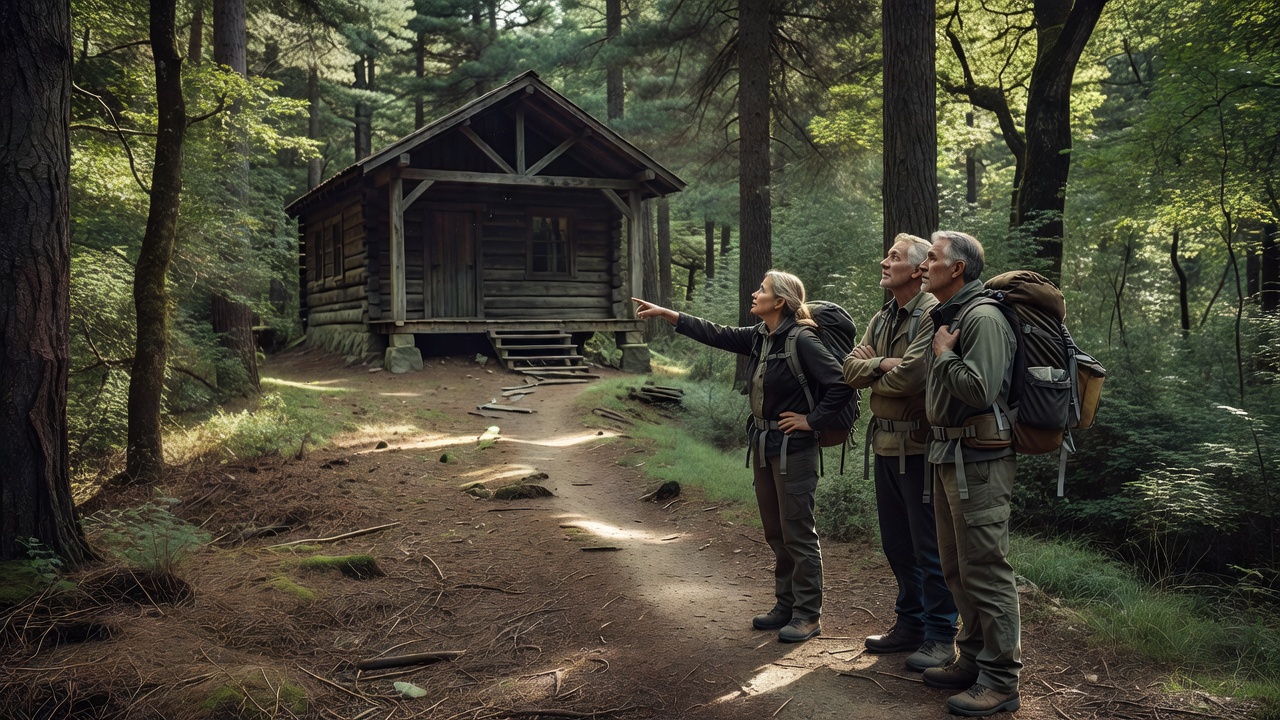
Separate privacy from isolation
Start by asking what you want to be away from. Traffic noise, busy footpaths and neighbouring windows are different concerns. A cabin near a small settlement may feel peaceful without putting food shops or medical help far out of reach. A building deep in managed woodland may still have forestry vehicles passing nearby. Photographs show a moment and a camera angle; they cannot establish the everyday soundscape or guarantee that you will see nobody.
Describe your needs to the provider in concrete terms. Ask whether another building is visible, whether a public path passes the entrance and whether forestry operations are expected during your visit. Confirm which outdoor spaces are private and which are shared. If you need step-free access, request measurements and photographs of the actual approach, thresholds and bathroom. Words such as “easy” and “accessible” are not detailed enough to make that decision.
A forest road can be the right compromise
A road-access cabin is often a useful starting point for independent travellers who are new to northern woodland stays. In the Cairngorms National Park or around Inverness, for example, a forest setting does not automatically mean a long expedition. However, the final road may be private, unsealed or poorly suited to a low-clearance vehicle. Ask about potholes, turning space, gates and the distance from the designated parking area to the accommodation.
Check the rental agreement if you are hiring a car. Permission from a cabin owner to use a track does not override the vehicle supplier’s conditions. In winter, also ask who clears snow, when clearance usually happens and what you should do if the road becomes unsafe. A four-wheel-drive vehicle is not a substitute for suitable tyres, route knowledge or the willingness to stop. Have a realistic alternative place to stay if access changes.
Treat a walk-in cabin as a carrying journey
Walking the last stretch can create a gentle transition, provided the route matches your group. Ask for distance, elevation gain, surface, river crossings and route markings rather than a single walking-time estimate. A path that takes a confident host a few minutes can take much longer with children, restricted mobility, wet ground or heavy bags. Think about the return journey as well: rubbish, wet clothing and tired legs will all come back with you.
In regions such as Dalarna and Värmland in Sweden, or Kainuu in Finland, wooded landscapes can contain a mixture of private rentals, managed trails and different kinds of shelters. Do not assume that a mapped hut is private accommodation, reservable or supplied with bedding. Confirm the exact type of building and your right to occupy it. A wilderness shelter and a serviced rental cabin can require very different equipment and expectations.
Water adds another decision-maker
A lake crossing or ferry approach makes your journey dependent on more than a road timetable. In Finland’s Lakeland, ask whether a property is reached by a scheduled service, a host-operated boat or a craft you are expected to handle yourself. Establish who supplies correctly fitting buoyancy equipment, who makes the weather decision and what happens if the crossing is cancelled. Never assume a photograph of a rowing boat is an invitation or evidence of safe access.
Keep the outward and return journeys flexible. A still morning says little about the wind on departure day. Do not make an essential international connection depend on an unbuffered small-boat crossing. If ice is mentioned, obtain current local guidance and a professionally managed access arrangement; do not infer that a frozen surface is safe to cross. The simplest suitable setting may be the one that keeps water as scenery rather than transport.
Read the services as carefully as the setting
Make a short list of non-negotiables before considering interiors. These might include dependable heating, an indoor toilet, potable water, a working refrigerator or a phone connection for essential responsibilities at home. Ask whether electricity is continuous, whether hot water is limited and whether cooking equipment suits the meals you intend to make. Off-grid can mean several different systems; it is not a precise promise of comfort, sustainability or self-sufficiency.
Finally, choose for the group you actually have, not an imagined more adventurous version. A shorter approach and a nearby village can leave more energy for noticing the woodland. Ask providers directly about current conditions, and use official destination information for the wider area. The Cairngorms National Park and Visit Sweden offer useful regional context, but neither replaces property-specific answers. Once the setting fits, work through the final-arrival plan.